I Asked AI to Help Me Read My Great-Grandfather's Homework. It Failed Spectacularly.
A 100-year-old Cantonese children's book exposed surprising blind spots in our most advanced AI systems. Sometimes the best stress tests come from the most unexpected places.
这篇暂时只有英文版。
When Dad Becomes Your Research Assistant
My dad texted me a photo yesterday from his antique shop. “Found this old Cantonese children’s book from the 1920s,” he said. “Thought you might find it interesting.”
I opened the image and immediately felt that familiar mix of nostalgia and confusion. I could mostly read it—traditional Chinese characters arranged in neat columns, reading right to left, top to bottom. But there were nuances I wasn’t catching, cultural references that felt just out of reach.
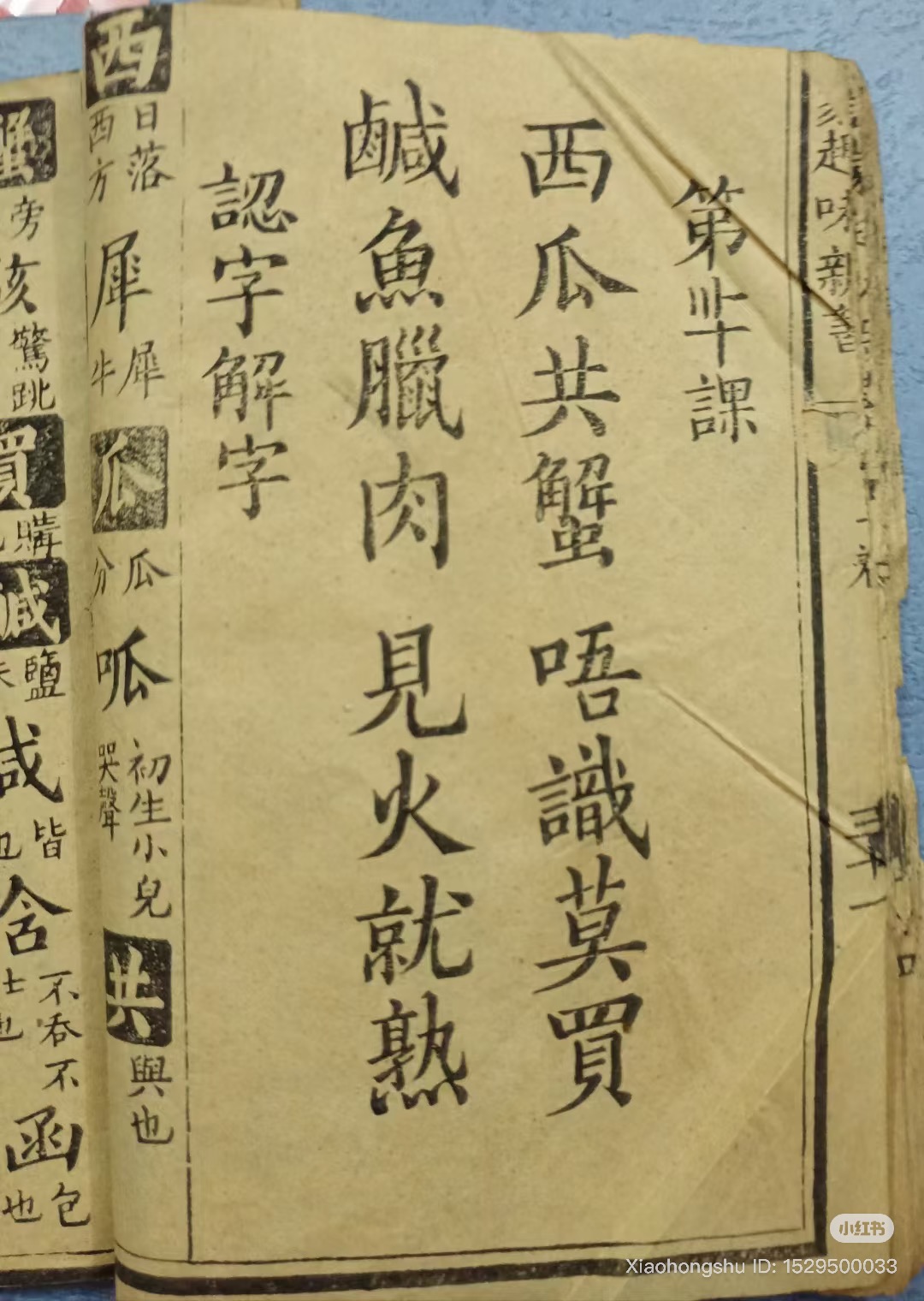 The page that started it all: A 1920s Cantonese children’s book that reads “西瓜共蟹,吾識莫買;咸魚臘肉,見火就熟” (Watermelons and crabs, if you don’t know, don’t buy; salted fish and cured meat, cook when they see fire). The text teaches practical market wisdom—advising beginners to avoid complex purchases like watermelons and crabs that require knowledge to choose well, and instead start with simple ingredients like salted fish and cured meat that are easy to prepare. What made it even more intriguing was the lesson number written in 苏州码 (Suzhou numerals)—a traditional Chinese commercial notation system dating back to the Southern Song period that I had to research to understand1. It’s a charming slice of 1920s street-smart learning with layers of cultural complexity.
Perfect job for AI, right?
Plot Twist: I Became My Own Research Assistant
While waiting for Claude to process the image, I got impatient. A quick Google search about 1920s Cantonese children’s literature led me down a fascinating rabbit hole. Within 20 minutes, I had fully decoded the text, understood the cultural context, and even learned about the Republican era’s literacy campaigns.
Then Claude came back with its response.
“I can see this appears to be Chinese text, but I’m having difficulty making out the specific characters…”
Wait. What?
The Great AI Stress Test
That’s when things got interesting. If one AI couldn’t handle this, what about the others? I decided to run my own little experiment:
OpenAI O3: Nailed it. Not only read every character correctly but explained the cultural context and even noted the historical significance of the reading direction.
Google Gemini 2.5 Pro: Partial credit. Could recognize most characters but completely missed the meaning and cultural nuances.
Claude Opus: Epic fail. Couldn’t even identify half the characters, let alone understand what it was looking at.
Here’s the kicker: any modern Cantonese speaker can read this 100-year-old text without breaking a sweat. But two of our most advanced AI systems? Total confusion.
The Linguistic Time Machine
This little discovery sent me down another research spiral. Turns out, this isn’t just a random old book—it’s a testament to the remarkable stability of written Chinese over the past century.
The traditional Chinese character system has remained essentially unchanged since the Han dynasty around 200 BCE2. By the 1920s, when this book was published, written Cantonese had developed into a well-recognized system, particularly with the rise of Cantonese opera libretti3. The Republican era was also a time of significant literacy campaigns and children’s book publishing, making materials like this crucial for understanding both language preservation and cultural transmission4.
What’s fascinating is that modern Cantonese speakers in Hong Kong, Macau, and overseas communities can effortlessly read these century-old texts, thanks to the continued use of traditional characters and the stability of the writing system5. It’s like having a linguistic time machine that works perfectly for humans but apparently breaks AI.
The Lightbulb Moment
Staring at these results, I realized something wild: I might have accidentally discovered the perfect AI benchmark.
Think about it:
- Layout Challenge: Can AI understand traditional reading patterns (right-to-left, top-to-bottom)?
- Character Recognition: Can it handle traditional Chinese in historical context?
- Cultural Comprehension: Can it grasp the deeper meaning and cultural references?
This tiny children’s book had just exposed massive blind spots in billion-dollar AI systems.
Recent research shows that Cantonese remains significantly under-resourced in AI development despite being spoken by over 85 million people worldwide6. The challenges are compounded when dealing with historical texts, where OCR systems struggle with variations in handwriting, printing styles, complex layouts, and the sheer number of character types needed for useful recognition7.
The Wild Idea That Won’t Leave Me Alone
What started as “let me ask AI for help” became “wait… did I just accidentally discover something?”
Staring at these results, this crazy thought hit me: What if this little book is the perfect AI stress test?
Think about it:
- Any Cantonese speaker can read this effortlessly
- Two of the world’s best AIs completely failed
- I’m sitting in a shop that… wait, how many of these do we actually have?
I keep thinking… wouldn’t it be fun to build CantoBench? A benchmark where 1920s children’s homework stumps billion-dollar AI models:
Level 1: Can you read right-to-left, top-to-bottom?
Level 2: Can you transcribe these historical characters?
Level 3: Can you understand what great-grandma was actually trying to teach?
I mean, I should probably dig through the shop first and see what we’ve got. Maybe this was just a lucky find, or maybe we’re sitting on a goldmine of AI-breaking historical materials.
Either way, the idea is kind of delicious, right?
What This Reveals About AI’s Blind Spots
The performance differences between O3, Gemini, and Claude on this simple text reveal something important about current AI limitations. O3’s success likely stems from its advanced reasoning capabilities through reinforcement learning and what OpenAI calls “thinking with images”—the ability to integrate visual information directly into its reasoning process rather than just converting images to text8.
Meanwhile, research shows that even advanced models like Gemini 2.5 Pro can struggle with language switching and context preservation in multilingual scenarios9. The challenges are even greater for under-resourced languages and historical texts, where training data is scarce and cultural context is crucial.
This isn’t just about technical capabilities—it’s about cultural preservation. As AI becomes increasingly important for digitizing and preserving historical documents, these blind spots could mean that millions of cultural artifacts remain inaccessible to future digital preservation efforts10.
When Your Dad Accidentally Becomes an AI Researcher
For now, I’m just enjoying this weird moment where my dad’s random antique shop photo exposed something fascinating about our most advanced AI systems.
Maybe I’ll put some effort into this—either convince my dad to dig through more materials in China, or find some way to explore what other AI kryptonite might be hiding in that shop. Who knows what we might discover?
Sometimes the best discoveries happen when you’re just trying to understand your great-grandfather’s homework. And sometimes, the most important questions come from the most unexpected places—like a dusty corner of an antique shop where the past meets the future in ways we never imagined.
Who knew a 100-year-old children’s book could be such an AI troublemaker?
-
“Suzhou numerals - Wikipedia” - The Suzhou numerals developed from the Southern Song rod numerals and were used as shorthand in number-intensive areas of commerce such as accounting and bookkeeping, popular in Chinese markets until the 1990s. ↩︎
-
Traditional Chinese characters - Wikipedia. The modern shapes first appeared with the clerical script during the Han dynasty c. 200 BCE. ↩︎
-
Written Cantonese - Wikipedia. By the 1920s, with the rise of fully written libretti for Cantonese opera, a well-recognised system had arisen. ↩︎
-
Children’s literature in China - Wikipedia. The 1920s and 1930s saw major presses publishing large volumes of children’s books following the New Culture Movement. ↩︎
-
Debate on traditional and simplified Chinese characters - Wikipedia. Traditional characters continue to be used in Hong Kong, Macau, and Taiwan. ↩︎
-
“How Well Do LLMs Handle Cantonese? Benchmarking Cantonese Capabilities of Large Language Models” - arXiv, 2024. Despite 85+ million speakers, Cantonese remains under-resourced in NLP. ↩︎
-
“Detecting reading orders with block-based models for OCR for classical Chinese documents” - Multimedia Tools and Applications, 2025. OCR challenges include training data requirements for 5,000+ character types. ↩︎
-
“Thinking with images | OpenAI” - OpenAI, 2025. O3 and o4-mini can integrate images directly into their chain of thought. ↩︎
-
“Couldn’t switch language mid-conversation using Gemini 2.5 Flash” - Google AI Developers Forum, 2024. User reported difficulties with automatic language detection. ↩︎
-
“AI Meets Archives: The Future of Machine Learning in Cultural Heritage” - CLIR, 2024. AI’s role in digitizing and preserving cultural heritage materials. ↩︎