The Last Human Complaint About Bureaucracy
Bureaucracy persists because it’s organizational memory. AI will digest that memory—and mutate the iron cage into something faster and harder to appeal.
这篇暂时只有英文版。
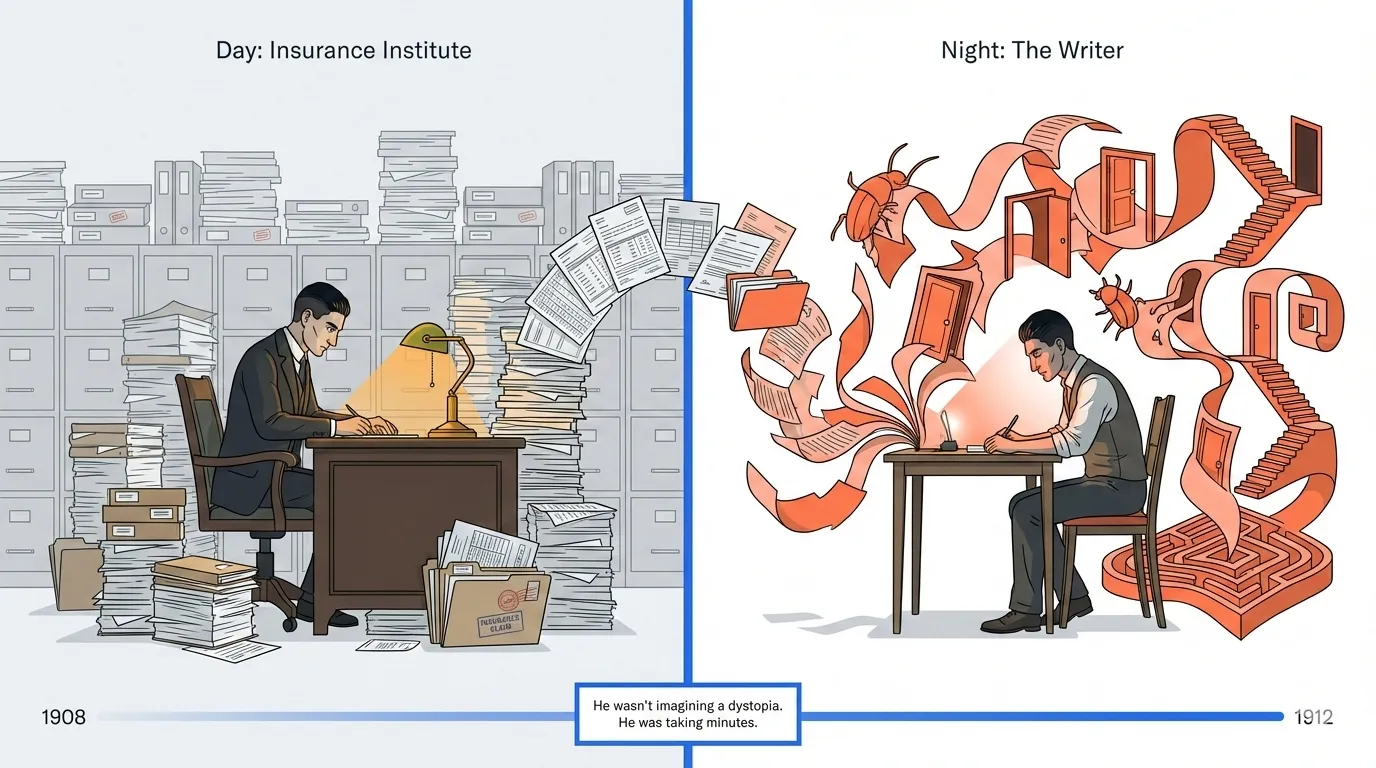
Franz Kafka spent his days inside the system we now use his name to describe.
By day, he worked at a workers’ accident insurance institute, reading claims and investigating workplace incidents.1 By night, he wrote stories where rules are everywhere, reasons are nowhere, and the process becomes the punishment.
Kafka wasn’t imagining a dystopia. He was taking minutes.
And yet a century later, the question still hangs there like a fluorescent light in a windowless office:
If bureaucracy is so universally hated, why is it everywhere? Why does it survive every reorg, every new leader, every “lean transformation” deck?
I think the usual answer (“because bureaucrats like power”) is incomplete. True, but incomplete.
The deeper answer is more uncomfortable:
Bureaucracy is an organism’s way of growing a memory.
And that memory—those SOPs and approval chains and “please attach your manager’s manager’s approval”—is now becoming the training data for the systems that will replace it.
Bureaucracy built its own executioner.
The final irony is that AI won’t kill bureaucracy. It will mutate it.
The Complaint Everyone Knows
Everyone has a bureaucracy story. Not a dramatic one. The slow, draining kind. The kind that doesn’t create a villain—just a calendar.
You want to do a simple thing—buy a tool, ship a feature, hire a contractor, change a process, access a dataset.
But first: fill out a form. Then fill out the form about the form. Then wait for three different people to “review,” none of whom are actually empowered to say yes, only to say no.
Bureaucracy has a particular way of consuming time without ever feeling like a single decision. It shows up as calendar invites (“alignment”), spreadsheet tabs (“intake”), and comments in a ticketing system (“please provide additional context”) that reset your waiting period back to zero.
If you zoom out, it’s easy to think bureaucracy is just incompetence at scale. But in my experience—across a dozen-plus years of building products and now building AI tools—it’s more like a tax on trust. The larger the organization, the less it can run on personal reputation. The process becomes the substitute.
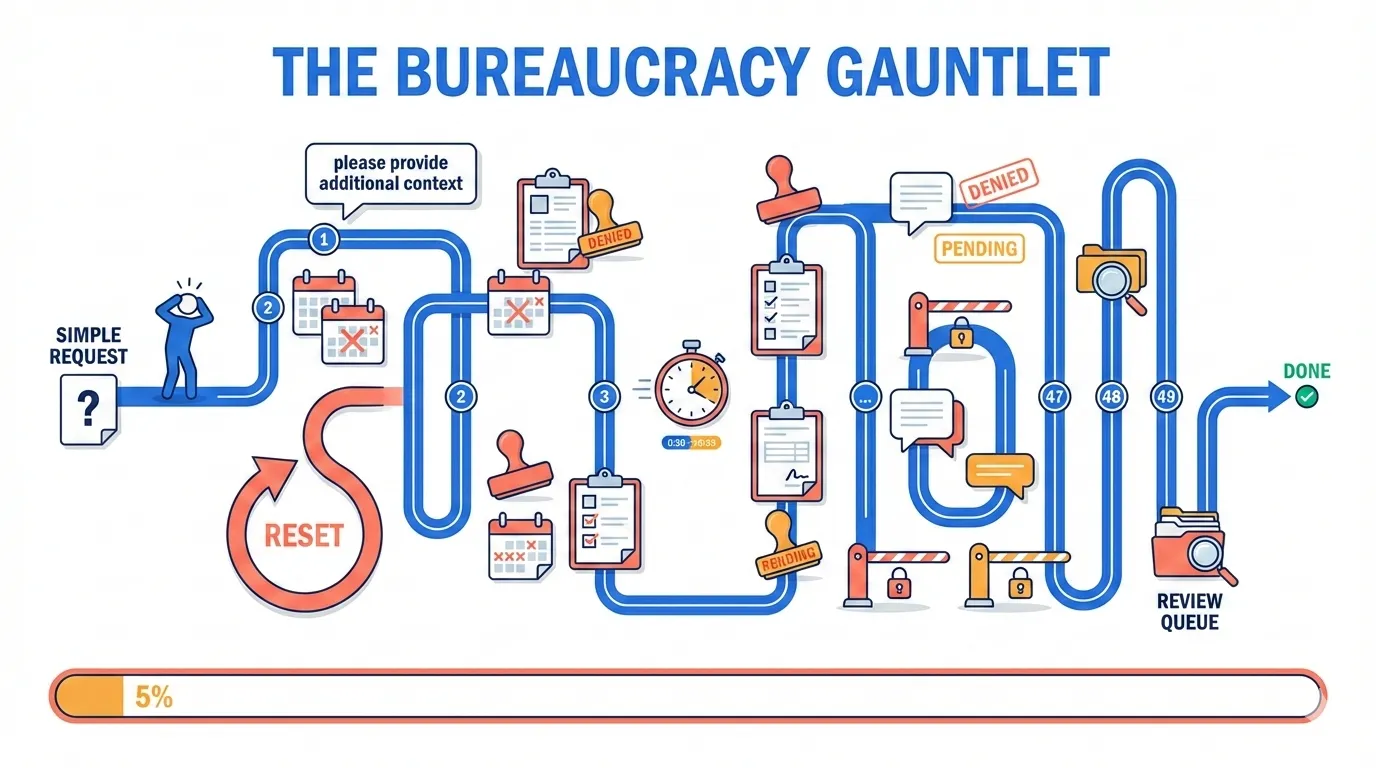
We have a word for it—Kafkaesque—because “absurd, opaque, soul-crushing process” is too long for casual conversation.
We also have a law for it—Parkinson’s Law—which is often remembered as “work expands to fill the time available.” But Parkinson’s sharper observation was about bureaucracies themselves: administrative headcount tends to grow regardless of how much work there is to do.2
Parkinson’s famous example is almost too perfect: even as the British Navy’s fleet shrank dramatically in the early 20th century, bureaucratic staffing kept growing.3 The machine outlived the mission.
These complaints are real. They’re also incomplete.
Because the interesting question isn’t “why is bureaucracy annoying?”
The interesting question is: why is bureaucracy resilient?
Bureaucracy as Institutional Memory
When organizations are small, they run on stories.
Someone remembers why a decision was made. Someone knows who owns which system. Someone can walk across the room and ask the person who “just knows.”
When organizations get big, stories stop scaling.
Not because people become less competent. Because the organization’s knowledge becomes larger than any one person’s head—and more importantly, larger than any stable social network.
People quit. People transfer. Teams rename themselves. The Slack channel gets archived. The doc is “in Confluence somewhere.” The person who truly understood the edge cases leaves, and the edge cases don’t.
Bureaucracy emerges as the compensatory mechanism: a crude, expensive, surprisingly effective form of organizational memory.
Max Weber—often cited as bureaucracy’s greatest critic—was also one of its clearest admirers. In its ideal form, he argued, bureaucracy optimizes for things organizations desperately need at scale: “precision, speed, unambiguity, knowledge of files, continuity…”4
That phrase—knowledge of files—is doing a lot of work.
Bureaucracy isn’t just rules. It’s records. It’s the insistence that decisions leave a trail, and that trails can be followed by strangers long after the original actors are gone.
If you’ve ever wondered why organizations keep inventing new forms, new ticket categories, new approval states, here’s a useful (if slightly depressing) translation: they’re building a database out of people.
Forms are the schema. Tickets are rows. Approvals are joins. Audit trails are write-ahead logs. And “policy” is the layer that makes it all feel morally legitimate.
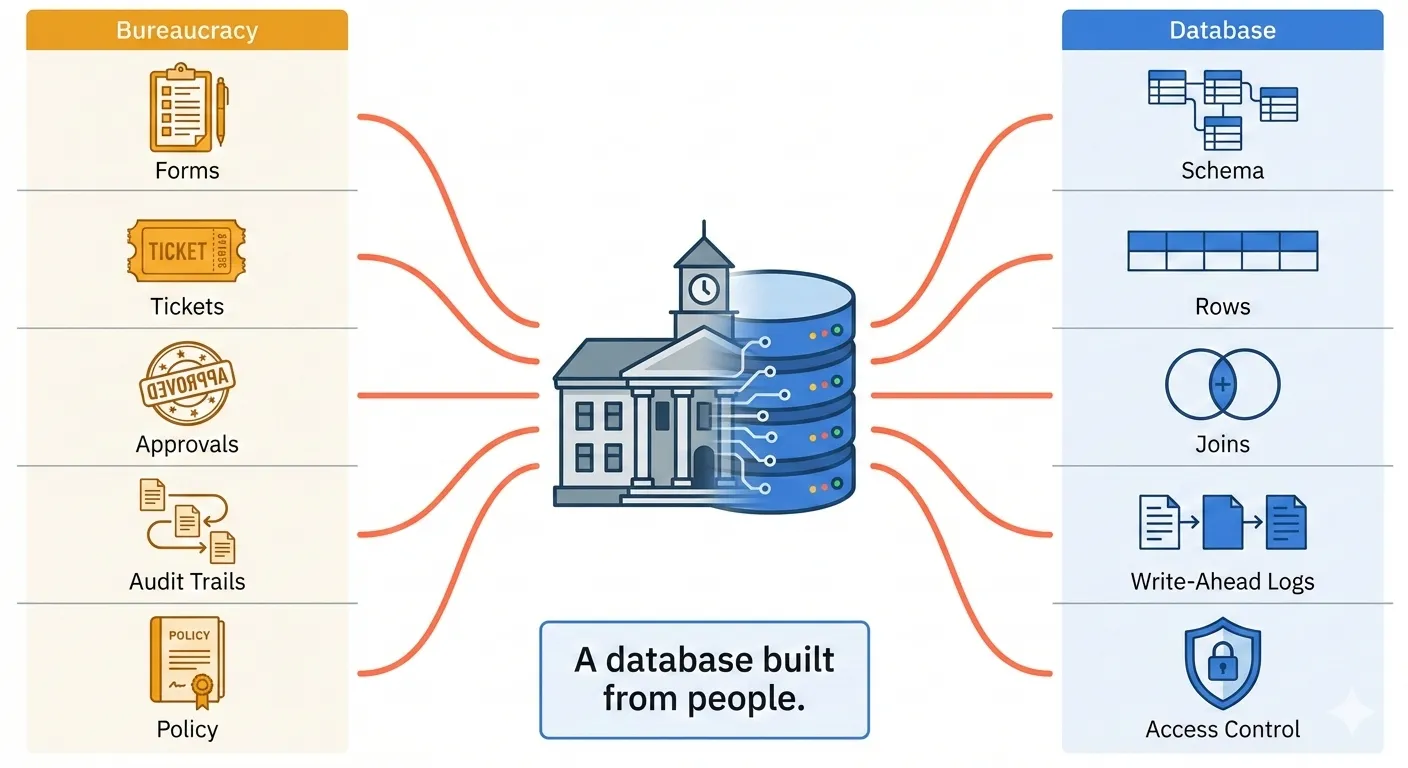
That last part matters, because bureaucracy isn’t just memory—it’s authorized memory. It decides which facts count, which decisions are binding, and which exceptions are allowed. That’s one reason “bureaucracy is about power” is both true and insufficient: the power comes from controlling the record, and the record is what keeps the organization coherent.
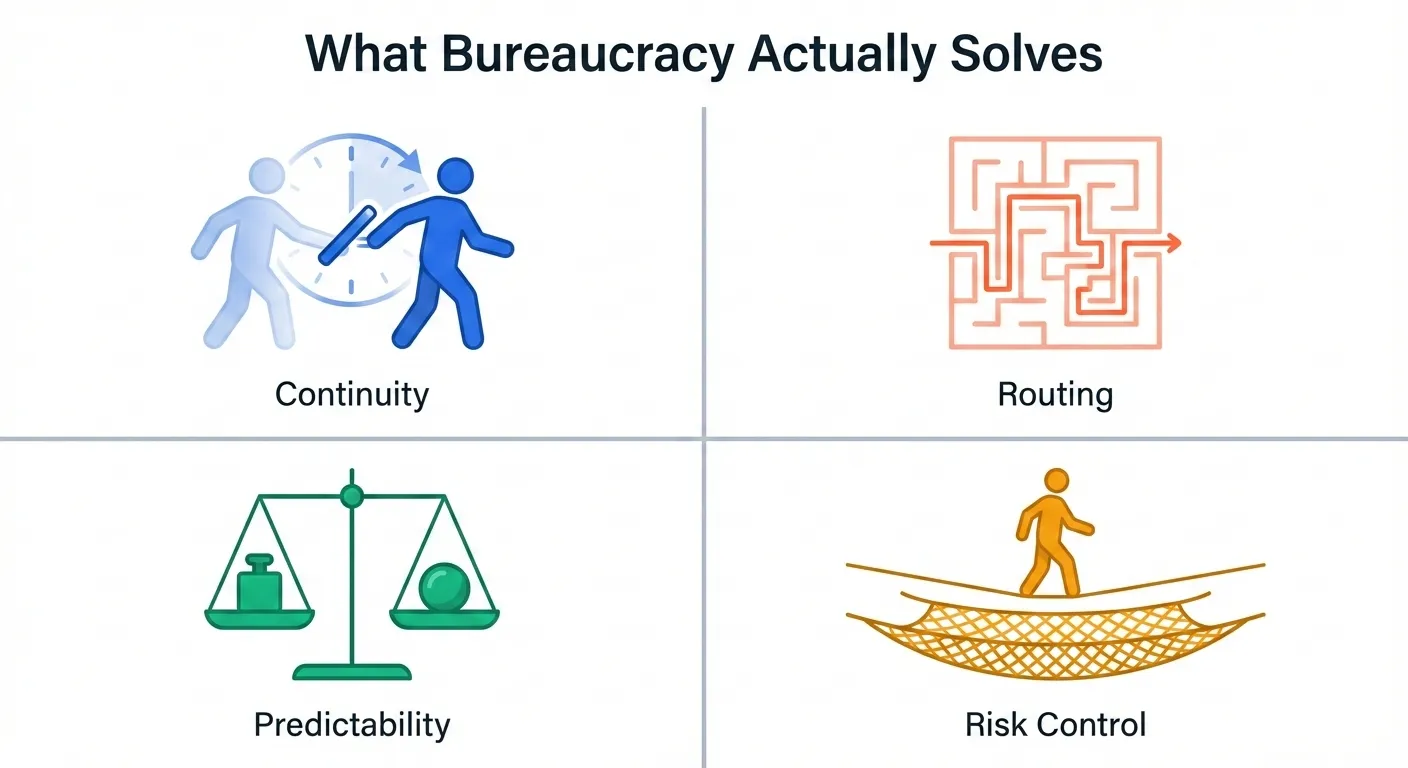
This is the part people skip when they complain: bureaucracy solves real problems.
It solves them imperfectly. But it solves them.
1) Continuity: the organization outlives the people
The core promise of bureaucracy is continuity: the organization can keep functioning even as individuals churn.
Rules make an organization less dependent on any specific leader; records make it possible to enforce those rules across time.5
If you’ve ever joined a company and thought, “Why do they insist on documenting everything?”, here’s the answer: because the alternative is to rebuild institutional knowledge from scratch every time someone quits.
2) Routing: you don’t need to know “who to ask”
In a small team, “routing” is social: you find the right person through relationships.
In a large organization, social routing becomes inequitable. The people with the best networks get things done; everyone else gets stuck. Bureaucracy replaces social routing with procedural routing:
Enter the process. The process finds the owner.
In theory, this is more fair. You don’t have to be an insider. You don’t have to know the VP. You just have to follow the steps.
The steps might be awful. But the promise is real.
3) Predictability: the same rules for everyone (in theory)
This is bureaucracy’s moral argument: impersonal rules reduce arbitrariness.
In the best case, it protects the weak from the whims of the powerful. In the worst case, it protects the powerful from accountability, because “the policy” becomes an alibi.
But the underlying need—predictability at scale—is not negotiable. Organizations that feel chaotic aren’t “free”; they’re expensive.
4) Risk control: compliance isn’t optional in some worlds
In heavily regulated domains—finance, healthcare, critical infrastructure—bureaucratic processes are not just annoying. They are safety mechanisms.
There are reasons you can’t “just ship.” There are reasons you can’t “just deploy.” There are reasons a second pair of eyes exists.
When bureaucracy works, it’s invisible. When it fails, it’s all you can see.
When Memory Becomes a Cage
Weber’s darker concept—the iron cage—wasn’t that bureaucracy is technically proficient. It was that technical proficiency can become its own prison.
The cage forms when the system starts optimizing for itself instead of the outcome it was designed to serve.
That shift is subtle. It looks like responsibility. It feels like professionalism. It sounds like “good governance.”
Then one day, you realize you’re no longer doing the work. You’re doing the paperwork of the work.
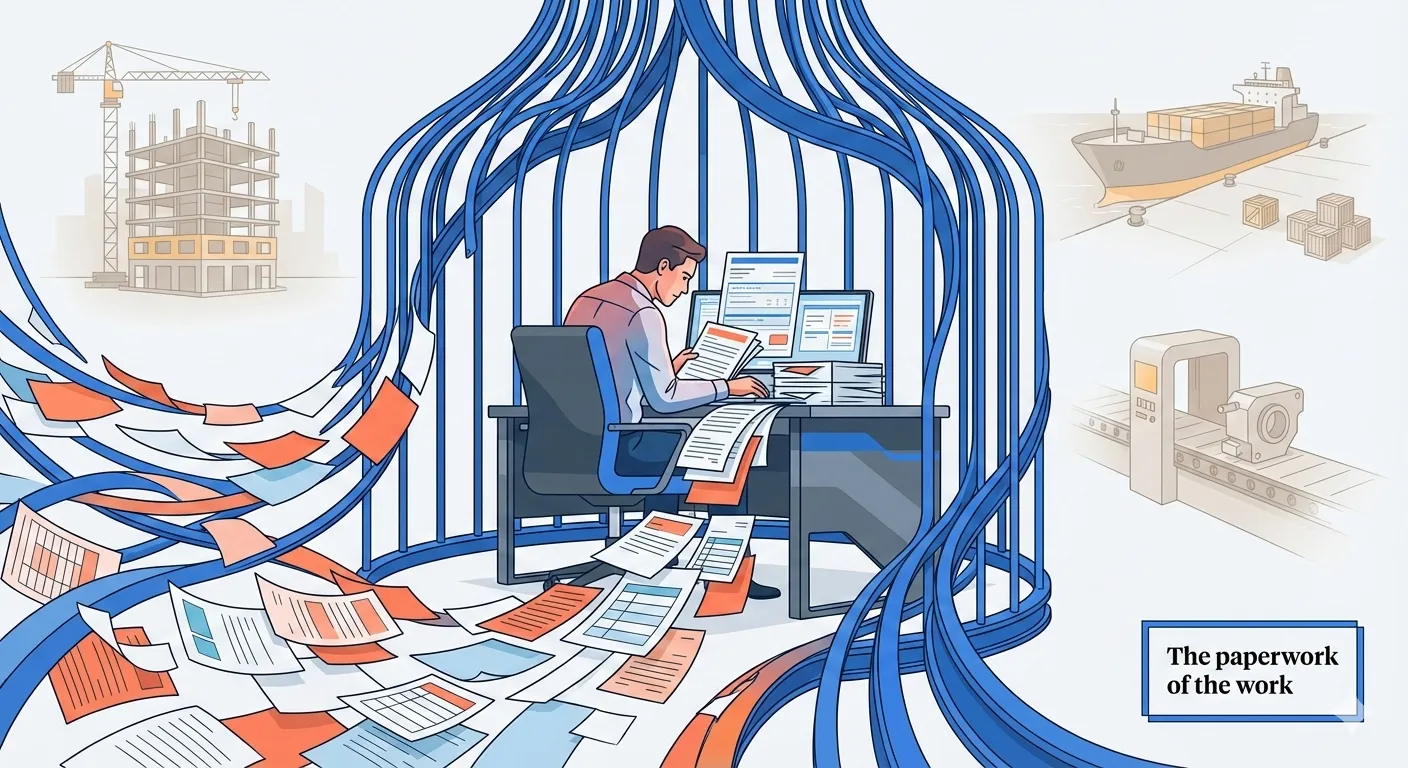
Here are the failure modes I’ve seen repeat across industries:
Rules accumulate; deletion is too dangerous
Every process has an origin story: a failure, an incident, an audit finding, a bad actor, a costly mistake.
So a rule gets added. A checklist item. A mandatory review.
What rarely happens is the corresponding cleanup. Nobody gets promoted for deleting a control. Plenty of people get blamed for deleting the wrong one.
There’s also no dramatic incident caused by too many rules—only slow suffocation. And suffocation doesn’t create a ticket.
Accountability becomes risk aversion
Many bureaucratic steps exist not to improve outcomes, but to distribute blame.
If something goes wrong, the question is not “did we build the right thing?” It’s “did we follow the process?”
Once “process compliance” becomes the measure of safety, innovation starts looking like recklessness. The safest career move is to say no, or to ask for more documentation, or to add a gate that ensures the next person owns the risk.
Formalization becomes theater
Harvard Kennedy School puts it bluntly: bureaucracy becomes a problem when it violates its own values and loses connection with purpose—when standardization turns into rigidity, formalization turns into pointless paper pushing, and accountability structures favor risk aversion over initiative.6
You still see the words—efficiency, fairness, responsibility—but the lived experience is delay, opacity, and learned helplessness.
This is the version of bureaucracy most people mean when they complain.
And it’s the version AI is about to eat.
Bureaucracy Built Its Own Executioner
When I say bureaucracy is organizational memory, I mean it literally.
The outputs of bureaucracy are information artifacts: SOPs, policy manuals, approval logs, process maps, ticket taxonomies, compliance checklists, audit trails.
And these artifacts have a peculiar property: they’re written in a style that is unusually compatible with machine execution.
They are step-by-step.
They are explicit about roles and responsibilities.
They define boundaries (“you may do X, you must not do Y”).
They encode institutional logic in a way that can be parsed—even if no human wants to parse it anymore.
Which is why modern enterprise AI adoption so often starts here: question answering over internal docs.
A knowledge bot is the first humane agent. It doesn’t “take your job.” It takes the burden of searching a thousand pages of policy prose for the one sentence that answers your question.
Some companies report surprisingly large gains from deploying internal knowledge assistants. Uber’s internal system “Genie,” for example, has been described as answering tens of thousands of internal questions and saving thousands of engineering hours since its launch.7
That’s the friendly version.
The more consequential version is when the system stops answering questions and starts running the workflow: routing requests, generating the paperwork, checking compliance, triggering approvals, updating records.
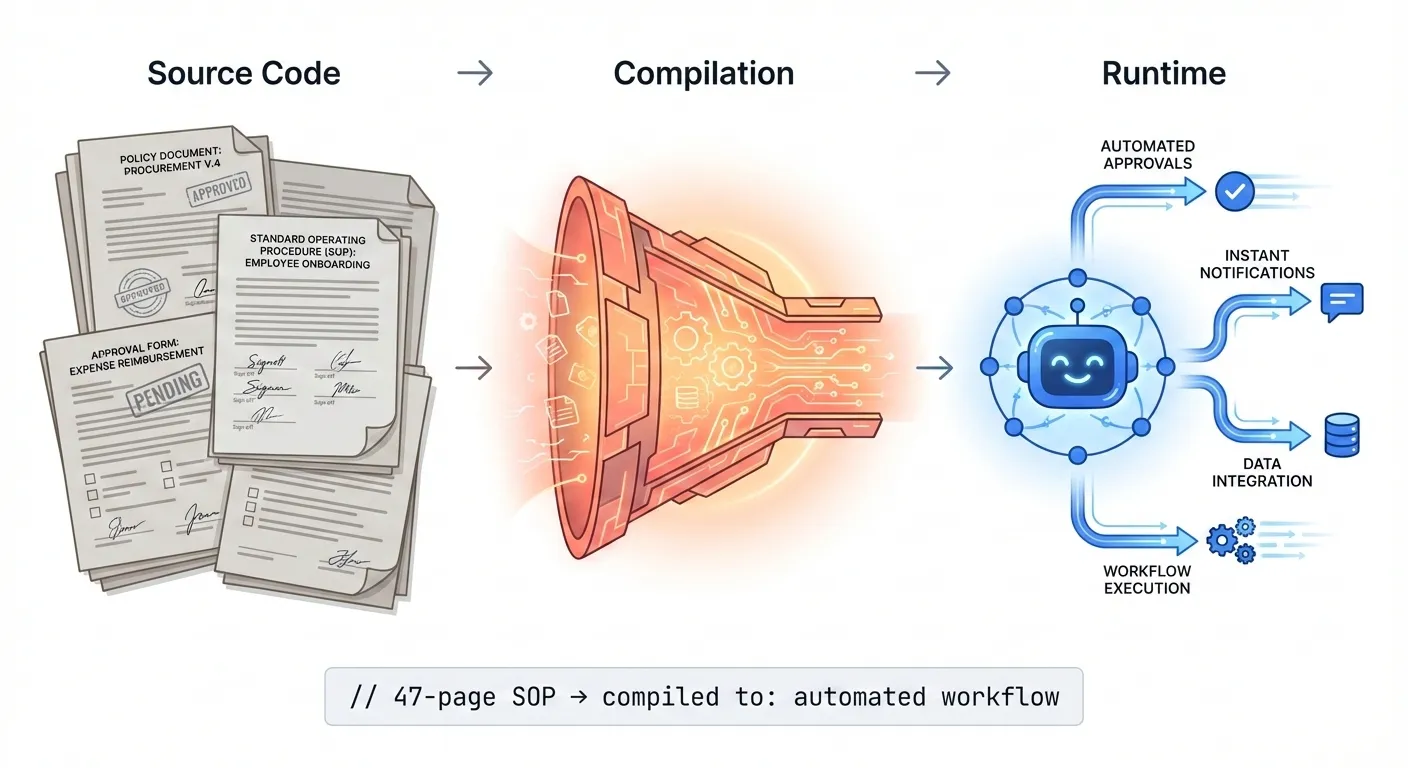
At that point, the bureaucracy isn’t being “reduced.” It’s being compiled.
In software, we often describe compilation as a move from flexible human-readable representation to fast machine-executable form.
That’s exactly what is happening to bureaucracy.
The documents were the source code. The agents are the runtime.
There’s one catch, and it’s a very Kafka catch: bureaucratic documentation is often aspirational.
Many organizations have a “process-as-written” and a “process-as-lived.” The written version is what survives in the wiki; the lived version is what actually gets things done. They diverge quietly over years, because the people doing the work adapt while the document stays frozen.
When you introduce AI, you risk hardening the wrong layer. An agent trained on the documentation might enforce a fiction. It might become incredibly efficient at doing what the organization thinks it does, rather than what it actually does.
This is why process mining and “process intelligence” tools can be such an uncomfortable mirror: they reveal that the 47-page SOP and the real workflow share a name, but not a shape.
The Mutation: From Iron Cage to Algorithmic Cage
This is where my optimism gets cautious.
I build AI tools because I want less bureaucracy. I’ve lived the friction, and I can’t unsee how much of it is pure waste. But the closer you get to automating bureaucracy, the more you discover a paradox:
Bureaucracy isn’t just slowness. It’s a governance model.
If you remove the humans and keep the governance, you don’t get freedom.
You get a new cage.
Here’s the shape of it:
| Old bureaucracy | New algorithmic bureaucracy |
|---|---|
| Slow, human-mediated | Fast, automated |
| You can argue with a person | You argue with a queue (or nothing) |
| Visible rules you can read | Opaque scoring you can’t see |
| Occasional oversight | Constant measurement |
| Discretion exists (sometimes) | Discretion gets engineered out |
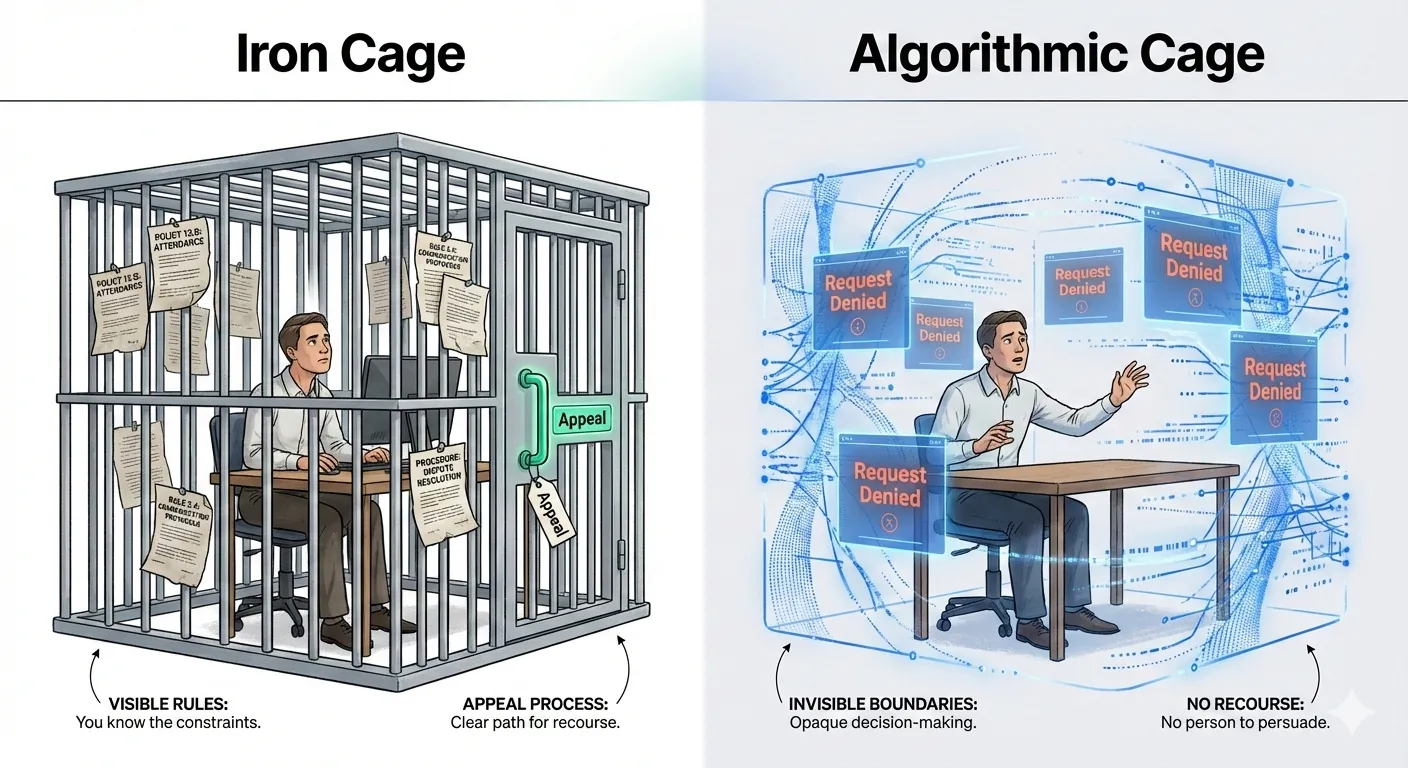
The old system was frustrating, but legible. You could find the policy. You could find the owner. You could escalate. You could build relationships. You could sometimes persuade.
The algorithmic version is less legible by default.
You might be rejected because a model flagged your request as “high risk.” You might be rate-limited because your behavior pattern looks anomalous. You might be routed into an automated process that never reaches a human because the system considers your case “resolved.”
And the most Kafkaesque part is that you might never know any of this happened. The UI just says: Request denied.
Two worlds inside one company
One pattern I keep noticing is a bifurcation of experience. If you’re close to decision-making, AI often feels like a tool: it drafts, summarizes, proposes options, runs analyses. If you’re close to execution, AI can feel like a boss: it assigns tasks, monitors performance, evaluates compliance.
In other words: AI can remove the bureaucracy above you while thickening the bureaucracy around you.
This isn’t dystopia. It’s just incentives.
Organizations adopt AI to reduce cost, reduce cycle time, and reduce variance. Those are rational goals. But reducing variance often means reducing discretion. And reducing discretion is, historically, how cages are built.
The new meta-bureaucracy: governing the agents
There’s another mutation most people miss: AI introduces its own layer of procedural overhead.
Once you automate decision-making, you also have to govern the automation: model risk reviews, auditability requirements, explainability expectations, monitoring and incident response, access controls and data lineage, “human-in-the-loop” escalation rules.
Some of this is absolutely necessary. But it means the bureaucracy doesn’t disappear—it moves, and it grows new organs.
You don’t eliminate the need for institutional memory. You just change its substrate.
The Last Observation
Why might this be the last human complaint about bureaucracy?
Not because bureaucracy goes away, but because the thing doing the bureaucracy stops being human.
And complaining, at its core, is an act of social negotiation. It assumes there is someone on the other side who can be persuaded, shamed, convinced, or simply empathized with.
What do you do when the gatekeeper is a system?
As an AI product manager, I sit in an awkward position. I’ve been the person waiting on approvals that seemed disconnected from reality. I’ve also been the person building systems that promise to dissolve those approvals into automated workflows.
Holding both perspectives at once leads me to a conclusion that feels less like a prediction and more like a responsibility:
If we don’t design the next generation of “bureaucracy” with legibility and recourse, we won’t escape the cage—we’ll just upgrade it.
In practice, “legibility and recourse” is not a philosophical slogan. It’s a product requirement.
It means people should be able to answer basic questions about any automated gate: What rule did I violate? What evidence was used? What would change the decision? How do I appeal to a human? If those questions can’t be answered, you haven’t built governance—you’ve built a black box with a badge.
Weber warned about an iron cage built from rationalization. We’re building something softer, faster, more adaptive—and potentially harder to see.
The real question isn’t whether AI will kill bureaucracy.
It’s whether we’ll notice when the new cage closes.
References
-
“Franz Kafka.” Wikipedia. https://en.wikipedia.org/wiki/Franz_Kafka ↩︎
-
“Parkinson’s law.” Wikipedia. https://en.wikipedia.org/wiki/Parkinson%27s_law ↩︎
-
C. Northcote Parkinson’s British Navy staffing example is widely cited; one accessible summary: “Parkinson’s law.” Wikipedia (see the section on bureaucratic growth). https://en.wikipedia.org/wiki/Parkinson%27s_law ↩︎
-
Max Weber, Economy and Society (discussion of bureaucratic administration); quote excerpted in many summaries, including Encyclopædia Britannica, “Bureaucracy.” https://www.britannica.com/topic/bureaucracy ↩︎
-
“Bureaucracy.” Encyclopædia Britannica (continuity, records). https://www.britannica.com/topic/bureaucracy ↩︎
-
Harvard Kennedy School (summary of when bureaucracy becomes dysfunctional: standardization → rigidity, formalization → paper pushing, accountability → risk aversion). Source cited in research notes. ↩︎
-
Uber “Genie” metrics are reported in vendor/industry writeups; one example: Xenoss, “Enterprise knowledge base” article. (See section on Uber Genie.) https://xenoss.io/blog/enterprise-knowledge-base ↩︎